
Medication adherence tracking means keeping a simple, shared record of which medicines your elderly parent should take, when, and whether each dose was actually taken, declined or missed. The most reliable version is a written medicines record that everyone involved can see and update, backed by reminders. It does not need to be complicated, but it does need to be consistent, because most problems start when two people each assume the other one did it.
If you are the person holding the whole picture in your head, or scrolling back through a family WhatsApp group to find out whether mum had her tablets, this guide is for you. It covers what to record, how to log a missed or uncertain dose, what tracking can and cannot tell you, and when to hand a question to a pharmacist or GP.
TL;DR
- Keep one up-to-date medicines record for your parent: each medicine's name, strength, timing, instructions and allergies. Ask the pharmacy or GP surgery for a printed list to start from.
- Log every dose on every occasion, including who prompted or helped and whether it was taken or declined.
- Agree in advance who does what, write it into the care plan, and make sure everyone has the same copy.
- Never give a double dose to make up for a missed one. Ask a pharmacist, GP or NHS 111 when you are unsure.
- Reminders and apps help, but they support a written record and a clear handover. They do not replace them.
Table of Contents
- What adherence tracking is, and why families need it
- Start with an accurate medicines record
- Decide who does what, and write it down
- What a good adherence log includes
- How to record a missed, late or uncertain dose
- What tracking can and cannot tell you
- Reminders, apps and dosette boxes
- Putting it into practice with KinCarer
- Keep repeat prescriptions and reviews in the loop
- When to speak to a pharmacist, GP or prescriber
- A simple weekly routine that keeps tracking honest
- FAQ
- Sources
What adherence tracking is, and why families need it
Adherence is simply how closely someone takes their medicines the way they were prescribed. Tracking is how you find out. For one person with one tablet a day, memory may be enough. Once your parent takes several medicines at different times, with some before food and some after, and with a brother, a neighbour and a home care agency all sometimes involved, memory stops being a system.
The problem is rarely carelessness. It is information. One person gives the morning dose and does not tell anyone. Another arrives at lunchtime and is not sure whether the morning dose happened. A hospital changes a dose and only one family member hears about it. A shared record closes those gaps.

There is also an emotional side. Many carers tell us they feel uneasy when they are not there at dose time, particularly if they live some distance away. A record that shows what has happened, and by whom, takes away a lot of that guessing.
Start with an accurate medicines record
Before you track anything, you need a correct list to track against. NICE, which publishes England's guidance on managing medicines for adults receiving social care, says to use an accurate, up-to-date medicines record, kept accessible in line with confidentiality expectations. It also recommends a medicines administration record, ideally a printed one supplied by the dispensing pharmacist, dispensing doctor or social care provider.
For each medicine, the same guidance says the record should include:
- your parent's identifiers, such as full name and date of birth
- the medicine name, formulation and strength
- timing or frequency
- the route, for example by mouth, patch or inhaler
- the GP practice
- any stop or review date
- special instructions
- known allergies
If you are the one setting this up, ask your parent's pharmacy or GP surgery for a current printed list, then check it against the boxes in the house. Mismatches are worth sorting out straight away with the pharmacist. Do not decide yourself which version is right.
The NHS also points out that giving medicines at the prescribed time matters, and that you should check whether a medicine should be taken with food or between meals, because incorrect timing or food instructions can reduce how well it works or cause side effects. Put those instructions on the record, not just the time.
If you want a ready-made layout, our shared medication schedule template and checklist is built for parents on five or more medicines, and our guide to a medication schedule for parents walks through building one that holds up in real life.
Decide who does what, and write it down
Tracking falls apart when roles are vague. NICE's public guidance says the care plan should state who helps with each medicine and what kind of help it is: prompting, practical assistance or actually giving the medicine. Everyone involved should have a copy.
In a family, that might look like this:
| Situation | Who helps | Type of help |
|---|---|---|
| Morning tablets with breakfast | Sister, who lives nearby | Gives the medicine and logs it |
| Lunchtime dose | Home care agency visit | Prompts, then records taken or declined |
| Evening dose | Mum herself | Self-administers, you ring to check |
| Weekly review of stock and refills | You, remotely | Checks the record and orders repeats |
The example is only an illustration. The point is that every dose has a named person and a named type of help. NICE also advises agreeing how family-given medicines will be recorded and including that arrangement in the care plan, so your own contribution is not the one part nobody writes down. Local NHS guidance in Nottinghamshire makes the same point from a safety angle: shared responsibilities recorded in the care plan and daily records support continuity and reduce the risk of an inappropriate dose or an overdose.
If you are still putting the wider plan together, our guide to setting up a shared care plan in one meeting can help you get everyone agreeing on roles at the same table.
What a good adherence log includes
A log answers one question for any person at any time: has this dose been dealt with, and how? NICE says a care worker should record support for each individual medicine on every occasion, including reminders, giving the medicine, and whether it was taken or declined. You are not a care worker, but the same standard is a sensible target for family carers.
Each entry should show:
- The medicine and dose, matching the medicines record.
- The date and time the dose was due and the time it was actually dealt with.
- What happened: taken, declined, missed, taken late, or not sure.
- Who was involved: who prompted, who helped, who gave it.
- A short note when something is unusual, such as nausea, a refusal, a new box from the pharmacy or a changed instruction.
Keep the wording plain. "Mum said she felt dizzy after the morning tablets" is more useful to a pharmacist than "possible side effect". You are recording what you saw, not diagnosing it.
Our article on a shared medication log goes through practical layouts if you want more examples.
How to record a missed, late or uncertain dose
This is where families most often freeze, so decide your approach before it happens.
Record it honestly and straight away. A log that only shows ticks is useless when something goes wrong. Local NHS guidance in Nottinghamshire says non-administration must be recorded with the reason and, where care workers are involved, reported to the line manager. Write down why: she refused, she was asleep, the box was empty, nobody was there.
Do not double up. The NHS carers' guidance is clear that you should not give a double dose to make up for a missed one, and that a pharmacist can suggest other ways to remember medicines.
Check before you help. NICE says a care worker should ask whether the person has already taken the dose and check the records before helping. A dose should not be left out for later unless the care plan agrees it. This is exactly why a shared record matters: two well-meaning relatives can otherwise give the same dose twice.
Ask when you are unsure what to do next. The Vale of Glamorgan carers' guide advises asking a pharmacist or GP if a forgotten dose leaves you uncertain about when the next dose is due. Marie Curie likewise suggests using the patient information leaflet and asking a pharmacist, GP or district nurse about unclear instructions, including what to do after a missed dose.
If it may have been taken twice, or a mistake has happened. Local NHS guidance says medication errors should be reported immediately and medical advice sought through the GP, NHS 111 or the out-of-hours service as appropriate. If your parent seems seriously unwell, call 999. Log what happened and what advice you were given, so the next person knows.
Remember: a missed dose is information, not a failure. Families who log them calmly give the pharmacist and GP something real to work with.

What tracking can and cannot tell you
A log is a very good way to see patterns, such as the Tuesday lunchtime dose that is always missed because the carer visit is late. It is less good at proving what actually went into your parent's body.
Researchers measure adherence in several ways: self-report, pill counts, pharmacy refill records, electronic monitoring and, in clinical settings, tests of the medicine in the body. A 2024 review of measurement methods describes electronic monitoring as among the most reliable approaches, and reports that in one comparison self-report overestimated adherence by 17% and pill counts by 8%. The same review notes that being monitored can itself change behaviour.
What this means for you in practice:
- A ticked box shows that someone says a dose was dealt with. It is strong evidence when the person ticking watched it being taken, and weaker when it is based on a phone call.
- Asking "did you take your tablets?" is useful but can flatter the real picture, especially if your parent has memory difficulties or does not want to worry you.
- A quick look at the box or blister pack, or at how quickly repeat prescriptions run out, is a helpful second check alongside the log.
- None of this tells you whether the medicine is working. That is a question for the prescriber or a pharmacist.
An honest log lets you spot a pattern early and raise it. It is not a way to catch anyone out.
Reminders, apps and dosette boxes
The NHS lists several ways to support a routine: telephone calls, visits arranged around dose times, automatic dispensers, labelled packets or smartphone apps. Which suits your parent depends on their eyesight, memory, confidence with technology and how many medicines they take.
Two cautions are worth knowing about pill organisers and blister packs:
- Black Country NHS formulary guidance says monitored dosage systems should be considered only after an individual assessment by a health professional, because not every medicine is suitable and treatment changes can create risks.
- Cheshire and Merseyside guidance says original packs are generally preferred and multi-compartment aids should be used only when there is an assessed, specific need.
So before you buy a weekly dosette box, ask the pharmacist whether it is suitable for your parent's medicines. They can also say whether any of them should stay in their original packaging.
A reminder tells your parent it is time. A record tells the family what happened. You need both, and a handover note ties them together when one person finishes and another takes over. Our comparison of medication reminder apps for UK families and our guide to medication list apps can help you decide what fits.
Our perspective
We built KinCarer because we kept hearing the same story. One relative becomes the organiser, everyone else wants to help, and the information lives in a dozen places: a notebook by the kettle, a text thread, a carer's memory. When it comes to medicines, that is where things slip.
We think the answer is a single shared care circle where the medicines list, the reminders, the notes and the handover updates sit together, and where relatives and paid carers can see the same information at the same time. That is how we have designed KinCarer to work, with permissions controlled by the family and one subscription covering every invited member.
We also believe tracking should lighten the load, not add to it. If recording a dose takes more effort than giving it, nobody will keep doing it. So we aim for quick check-ins, clear notes and an optional assistant, Clara, that helps you search and summarise what is already in your care circle. Clara does not give medical, legal or clinical advice. Questions about doses and side effects belong with a pharmacist, GP or prescriber, and we want your records ready for that conversation.
KinCarer
Putting it into practice with KinCarer
If you would like the record, the reminders and the handover notes in one place, KinCarer is a care planning app for families looking after an elderly parent or relative. You create a care circle, invite siblings, relatives and paid carers, add medication reminders, tasks, appointments, check-ins and notes, and everyone works from the same information. It is designed for families coordinating care, not for care homes or staff rota management.
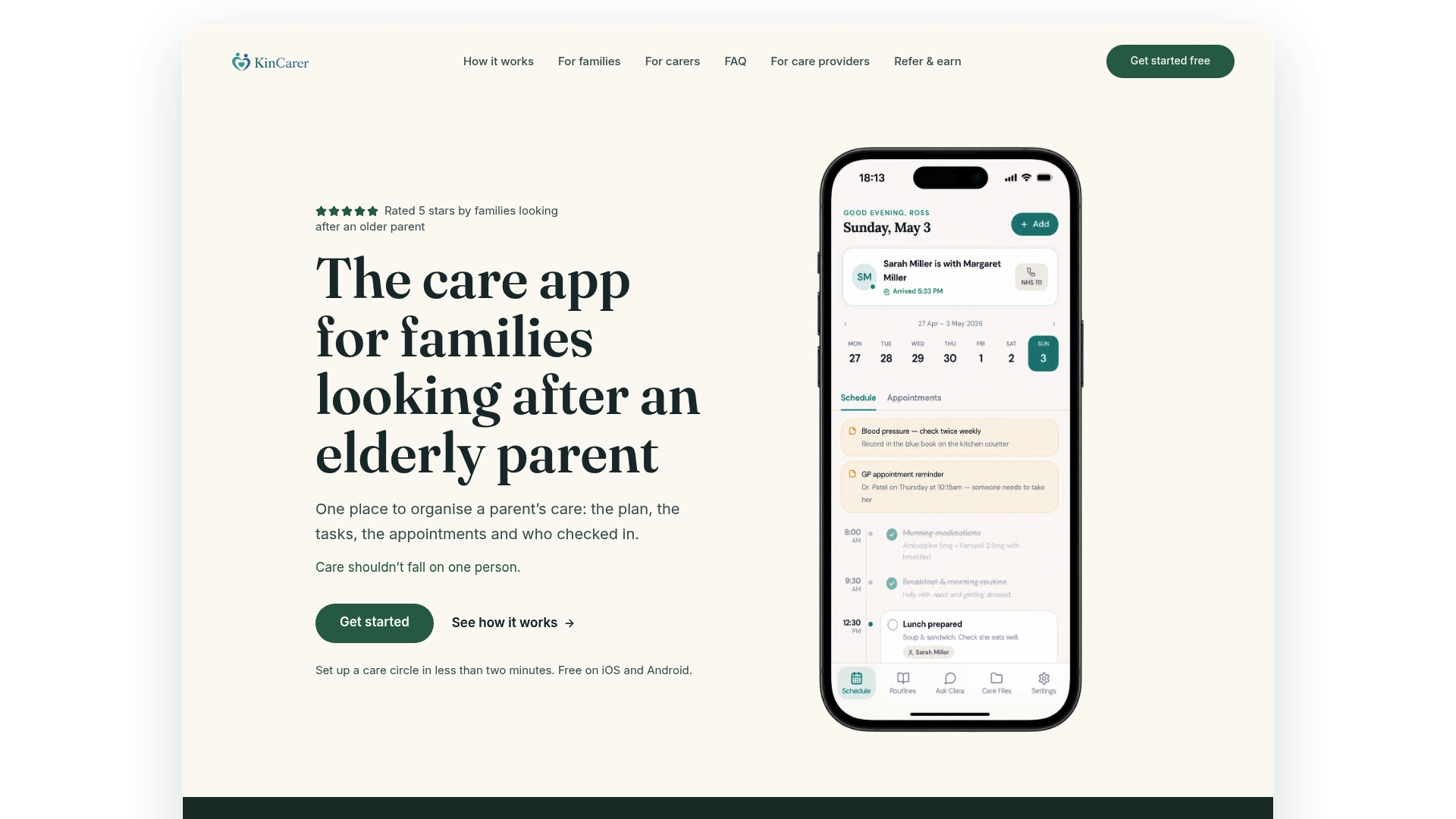
You can see how Family+ works for families or explore the KinCarer care app and set up a care circle for your parent. Plans are bought through the App Store or Google Play.
Keep repeat prescriptions and reviews in the loop
Tracking is only as good as your supply. A log that shows every dose was given is no help if the box ran out on Friday and the surgery is closed. Put repeat order dates in the same place as the doses, and agree who orders. Our guide to managing UK repeat prescriptions covers the practicalities.
The NHS also notes that a GP surgery may offer a free structured medication review with a pharmacist or another healthcare professional when someone takes several medicines. Your log is ideal preparation. Bring it along, together with the questions you have noted.
When to speak to a pharmacist, GP or prescriber
Your record helps you notice things. It does not tell you what they mean. The NHS advises speaking to a health professional, such as the prescriber or a pharmacist, about clinical questions. For care workers, NHS guidance lists the sort of concerns to raise: declined or incorrectly taken medicines, possible side effects, stockpiling, errors or near misses, capacity concerns, or changes in physical or mental health.
Family carers can use that list as a prompt. Make an appointment or call the pharmacy if you see:
- repeated refusals or missed doses at the same time of day
- tablets building up in drawers, or boxes emptying faster or slower than expected
- new confusion, drowsiness, dizziness or any change in mood after a medicine change
- difficulty swallowing, opening packaging or reading labels
- doubts about whether your parent can safely manage their own medicines
Take your log with you. Showing "missed 6 of the last 14 lunchtime doses" is much more useful than saying "she forgets sometimes".
A simple weekly routine that keeps tracking honest
Once the basics are in place, a few minutes each week keeps everything accurate.
- Check the list. Compare the shared medicines record with the boxes at home and any letters from hospital or the GP.
- Read the log. Look for gaps and patterns, not individual slips.
- Check supplies. Count what is left and confirm repeat orders.
- Share a short update. A two-line handover note: what went well, what changed, what needs doing.
- Note questions. Save anything for the pharmacist or GP in one place so you do not forget it on the day.
If you are coordinating from a distance, add a regular check-in with your parent or the person on site. Our article on check-ins for safety at home shows how families make these stick, and our guide to apps that make NHS visits count covers preparing for appointments.
FAQ
What is the easiest way to start tracking my parent's medicines?
Ask the pharmacy or GP surgery for a current printed medicines list, then record each dose against it as taken, declined or missed. Use one shared place that every helper can see, rather than separate notes. Agree who does what before you begin.
What should I do if I am not sure whether mum has taken her tablets?
Check the shared record first, and ask whoever was with her. Do not give another dose just in case, and never double up to catch up. If you still cannot tell, ring the pharmacist, her GP or NHS 111 for advice, and write down what you were told.
Is a dosette box better than an app?
They do different jobs. A dosette box sorts doses, while an app reminds and records. A pharmacist should confirm that a box suits your parent's medicines, because it is not suitable for every medicine. Many families use a reminder and a shared log either way.
Can KinCarer tell me if a medicine is working or give dosing advice?
No. KinCarer helps your family organise and share information, including medication reminders and notes. Clara, the optional assistant, helps you search and summarise what is in your care circle but does not give medical, legal or clinical advice. Speak to a pharmacist, GP or prescriber about clinical questions.
Sources
- NICE: Managing medicines for adults receiving social care in the community, recommendations
- NICE: Help to manage your medicines if you receive social care at home
- NHS: Medicines tips for carers
- Nottinghamshire medicines management: Home based care and support providers guidance
- Vale of Glamorgan: A carers guide to managing medicines
- Marie Curie: Helping someone take medication
- Black Country formulary: Guidance on the supply of monitored dosage systems
- Cheshire and Merseyside formulary: Multi-compartment compliance aids
- Medical Science Monitor: review of medication adherence measurement methods