If you are looking after an elderly parent, you will meet abbreviations almost straight away: on letters, discharge notes, benefit forms and in phone calls with professionals. This guide explains the ones UK carers come across most, grouped by where you are likely to see them, so you can look up a term and get on with the task in front of you.
TL;DR
- Most UK care abbreviations fall into five groups: benefits, NHS and health teams, social care, legal paperwork and daily living.
- Some abbreviations have more than one meaning, so always check the context and ask the person who used it.
- Medication shorthand such as bd or o.d. should be confirmed with a pharmacist, GP or nurse, never guessed.
- American lists use terms like PCP, ER and CNA, which are different in the UK (GP, A&E, HCA).
- Keeping a short glossary inside your family's shared care notes means nobody has to ask what a letter means twice.
Table of Contents
- Why care is full of abbreviations
- Benefits and money abbreviations
- NHS and health team abbreviations
- Social care and care services abbreviations
- Legal and planning abbreviations
- Daily living: ADL and IADL
- Medication shorthand
- UK and US terms: why some lists confuse
- A note on labels for people
- How to check an abbreviation you don't recognise
- Keeping a shared glossary with your family
- Perspective
- Put the jargon in one place
- FAQ
- Sources
Why care is full of abbreviations
Health and social care professionals write quickly, and abbreviations save them time. For you, reading a letter about your mum at the end of a long day, they can feel like a locked door.
The NHS itself recognises the problem. NHS England Digital's style guidance says to explain an abbreviation in full the first time you use it, unless it is as well known as NHS or GP. Alzheimer's Society makes a similar point about plain language and avoiding labels. So if a term is not explained, you are right to ask.
Remember: you are not expected to know this vocabulary. Nobody learns it until they need it.
Benefits and money abbreviations
These turn up on forms and letters from government departments and councils. Many people caring for an elderly parent are surprised by how many different benefits have similar names.
| Abbreviation | Stands for | What it relates to |
|---|---|---|
| AA | Attendance Allowance | Help with extra costs for an older person with care needs |
| CA | Carer's Allowance | A benefit for some people providing regular care |
| DLA | Disability Living Allowance | A disability benefit; it appears in GOV.UK's DWP abbreviations glossary |
| PIP | Personal Independence Payment | A disability benefit for working-age adults |
| DWP | Department for Work and Pensions | The government department that runs most benefits |
| PB | Personal Budget | Money set aside to meet someone's assessed care needs |
| C/C | Care component | Part of some disability benefit awards, as listed in the DWP glossary |
The same DWP glossary also includes less obvious entries such as CBD (Central Benefit Directorate), which you might only meet on correspondence about a claim. Rules and amounts change, so check the current position on GOV.UK or with Citizens Advice before you act on any of the above.
NHS and health team abbreviations
Hospital and community teams use shorthand constantly. These are the ones families most often ask about.
| Abbreviation | Stands for |
|---|---|
| A&E | Accident and emergency |
| BP | Blood pressure |
| OT | Occupational therapist |
| GP | General practitioner |
| HCA | Healthcare assistant |
| MDT | Multi-Disciplinary Team |
| SALT or SLT | Speech and language therapy |
| ICB | Integrated Care Board |
| ICU | Intensive Care Unit |
| HDU | High Dependency Unit |
| CPN | Community Psychiatric Nurse |
A&E, BP and OT all appear in the NHS App's official abbreviation guide, which also covers clinical shorthand such as AF (atrial fibrillation) and # (fracture). The guide's advice for anything unclear is simple: ask your healthcare professional.
An MDT is a group of professionals from different disciplines who discuss one person's care together. Oxford Health NHS Foundation Trust's carers' glossary uses it, along with AMHP (Approved Mental Health Practitioner) and CAMHS (Child and Adolescent Mental Health Services). If your parent has been discharged, an MDT meeting is often where the plan for going home gets agreed. It is worth asking whether you can be involved.
Social care and care services abbreviations
This group covers councils, regulators and assessments. It matters when you are arranging a home care agency or care provider, or asking the council for help.
- CQC (Care Quality Commission): the regulator of health and social care services in England, as explained in Devon County Council's adult social care jargon buster. You can use it to check how a home care agency or care home is regulated.
- CHC (Continuing Healthcare): NHS-funded care arranged for some people with ongoing, complex health needs.
- FNC (Funded Nursing Care): NHS contribution towards nursing care for people in some care homes.
- ACSP (Adult Carer Support Plan): the carer's assessment document used in Scotland only.
- DoLS (Deprivation of Liberty Safeguards): legal safeguards for people who lack the capacity to consent to their care arrangements and may be restricted.
- SW: social worker or support worker, depending on context.
- RA (Risk Assessment): a written look at what could go wrong and how to reduce it.
One point worth knowing: local authorities must offer carers an individual assessment of their own needs, separate from the assessment of the person they care for. If you have never had one, our guide to using the Care Act to prevent burnout and get respite explains how to ask.
Older lists also mention CCG (Clinical Commissioning Group). In England these have been replaced by ICBs, so you may see both on older letters.
Legal and planning abbreviations
- LPA (Lasting Power of Attorney): a legal document that lets someone you choose make decisions for you if you lose the ability to. There are different types, for property and finances and for health and welfare.
- DNR (Do Not Resuscitate): a decision about whether attempts to restart the heart or breathing should be made. It is a clinical and personal decision, so talk to your parent's doctor if it comes up.
- DoLS: see above.
These are serious documents. If you are unsure about an LPA or a DNR decision, speak to a solicitor, your parent's GP or a charity helpline instead of working from a glossary. Our article on care documentation for family carers covers which papers are worth keeping together and where.
Daily living: ADL and IADL
These two come up in care assessments and are worth understanding properly because they shape what help is offered.
- ADLs (Activities of Daily Living): basic personal care and mobility around the home, such as washing and dressing.
- IADLs (Instrumental Activities of Daily Living): tasks that support living independently, such as shopping and managing bills.
The Health Survey for England 2018 social care report uses both to measure social care need and receipt. In practice, an assessor may ask whether your mum can manage each activity alone, with prompting or only with help. Writing down what you see across a normal week gives you a better answer than guessing on the day. Our daily task list for UK families is a good starting point for that.
Medication shorthand
Prescription labels and care notes sometimes use Latin-derived shorthand for how often a medicine is taken. The NHS App's list includes o.d. (once a day), bd (twice a day), t.d.s. (three times a day) and q.d.s. (four times a day).

Use this as a way to read what you are given, not as a way to decide anything. If the instructions are unclear, ask the pharmacist, GP or nurse.
When you write medicines into your own notes, spell things out. Health safety bodies treat error-prone abbreviations and dose expressions as a recognised cause of medication errors, and they say such terms should not be used in communications about medicines. That guidance comes from Australia, but the principle suits any family sharing medicine information: "twice a day" is clearer than "bd", especially if a relative or paid carer is reading it in a hurry.
UK and US terms: why some lists confuse
The top search results for this topic are mostly American, and they include terms that do not match UK practice. The international standards committee on caregiving notes that "carer" is more common in the UK and Europe, while "caregiver" is more common in North America.
Here is how common American shorthand maps across, based on one dietitian's UK and US terminology comparison:
| US term | UK equivalent |
|---|---|
| ED or ER | A&E (accident and emergency) |
| PCP | GP (general practitioner) |
| CNA | HCA (healthcare assistant) |
| NPO | NBM (nil by mouth) |
| Operating room | Operating theatre |
Some American entries, such as SNF (skilled nursing facility), Medicaid terms or DHS, simply have no direct UK equivalent. If a list mentions them, you can skip them.
A note on labels for people
Abbreviations can also reduce a person to a label. Alzheimer's Society advises against short forms such as PWD to describe people with dementia, and suggests terms like "person living with dementia" in its positive language guide. The same guide suggests avoiding the word "burden" and keeping a clear difference between paid care workers and unpaid carers.
Even the word "carer" does not suit everyone. NICE's guideline evidence notes that some people supporting a family member or friend do not identify with it. If you feel more like a daughter or a husband than a carer, that is a normal reaction, and it is fine to use whichever words you and your family prefer.
How to check an abbreviation you don't recognise
- Look at who wrote it. A GP surgery, a council and the DWP use different shorthand. The same letters can mean different things in each.
- Check the letter or document for a glossary. Many councils and NHS trusts publish a jargon buster for carers.
- Search with the context. Add words such as "NHS", "benefit" or "care plan" to your search.
- Ask the sender. The NHS App guide advises asking your healthcare professional if you are unsure. Phone or message and say plainly: "Can you tell me what that stands for?"
- Write the full term down. Put the meaning into your shared notes the first time you learn it.
For anything medical, legal or financial, treat the glossary as a prompt for a question, not as advice.
Keeping a shared glossary with your family
If you are one of several relatives involved, jargon creates a hidden gap. The sibling who attended the hospital appointment understands "MDT" and "OT"; the one living three hours away does not. Messages then get misread or lost.
A few habits help:
- Write notes in full words, with the abbreviation in brackets once, as NHS style guidance recommends.
- Keep a short "what this means" list in one place everyone can find.
- When a professional uses a term, whoever is present adds the plain meaning to the note.
- Explain things to paid carers the same way. A new care worker coming in may not know your family's shorthand.
Our guides on setting up a shared care plan in one meeting and coordinating care remotely cover how to share this kind of information without leaving one person to explain everything.
Perspective
Most of the families we hear from do not struggle with the caring itself. They struggle with keeping track: who spoke to the district nurse, what the letter from the council meant, which appointment is next.
Abbreviations make that harder, because the person who understood the meeting is often the only one who knows what was decided. We think the fix is not a longer glossary but a shared place where the explanation sits next to the task or note it belongs to.
That is why KinCarer is built around a care circle: relatives and paid carers can see the same tasks, appointments, check-ins, medication reminders and handover notes. Our optional assistant, Clara, can help you search and summarise what is in your circle. Clara does not give medical, legal or clinical advice, so for what a term means clinically, you still ask the professional involved.
Our aim is simple: less carrying the caring load alone, and fewer messages buried in a group chat.
KinCarer
Put the jargon in one place
If you are tired of explaining the same letter to three relatives, a shared care circle can keep notes, appointments and tasks together. KinCarer lets you invite family and paid carers into one circle, so everyone works from the same information.
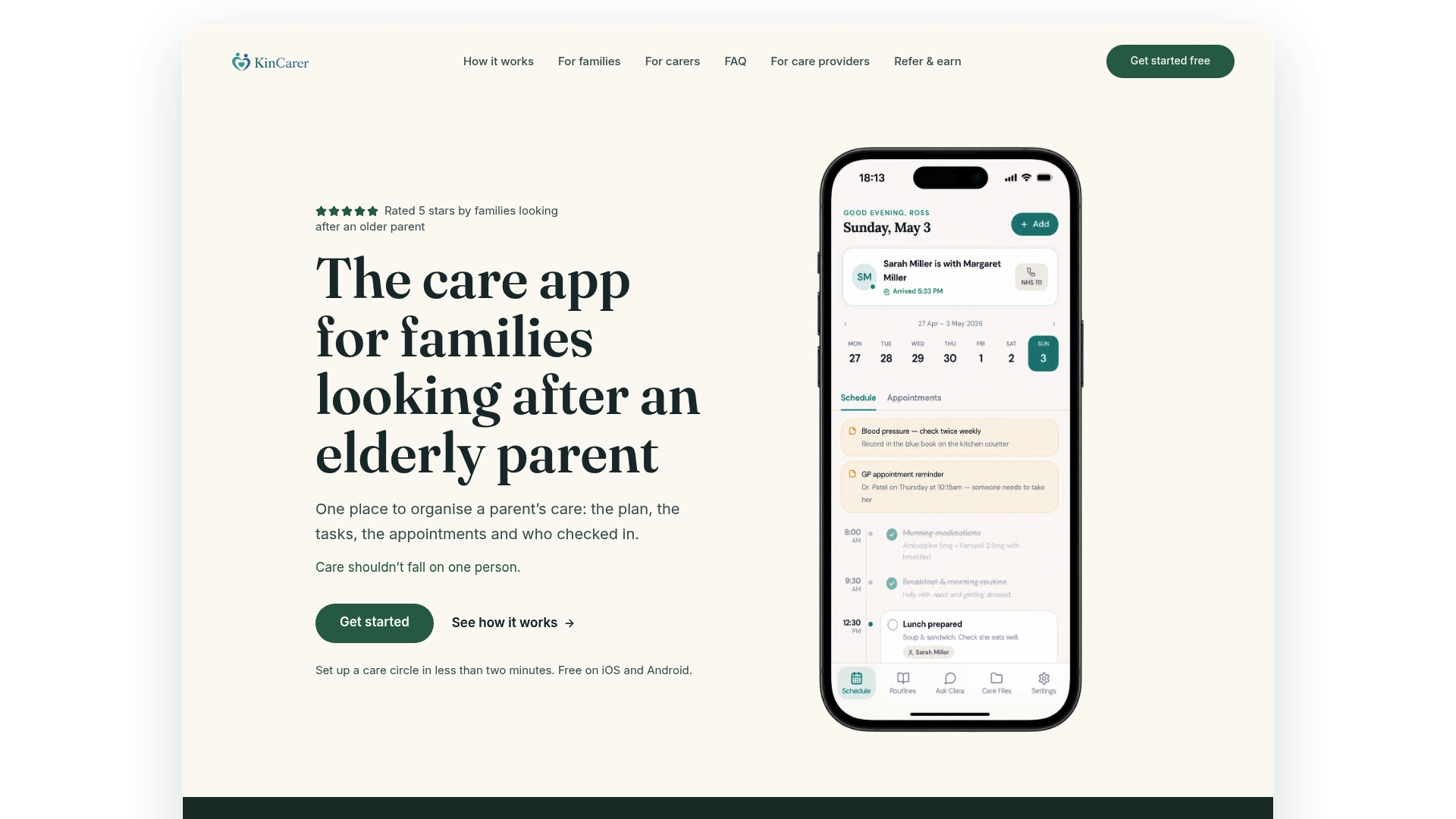
The Family+ plan is listed at £9.99 per month per family or £69.99 per year per family. You can see the details on the KinCarer Family+ page, or look at how the KinCarer care app for families works. If you want to compare what to look for first, read about caring app features that work with NHS proxy access.
FAQ
What does "carer" mean in the UK?
In UK usage, a carer is usually someone who gives unpaid support to a family member or friend. Paid staff are normally called care workers. The ISO caregiving terminology resource gives "care worker" as the preferred term for paid care providers.
Are US caregiver abbreviation lists useful in the UK?
Partly. Terms such as ADL and POA-type concepts exist in both countries, but many entries, like PCP, CNA, ER or DHS, reflect the American system. For UK paperwork, use a UK source such as a council jargon buster or the NHS App guide.
What should I do if a doctor or nurse uses an abbreviation I don't understand?
Ask them to explain it in plain words and write the answer down. The NHS App guide recommends asking your healthcare professional when you are unsure, and nobody should mind you asking.
Where can I find an official list of NHS abbreviations?
The NHS App help pages include an abbreviation guide covering common clinical shorthand. Local councils and NHS trusts, such as Devon County Council and Oxford Health, also publish jargon busters written for carers.
Does Clara explain medical abbreviations?
Clara helps you search and summarise the information already in your care circle. It does not give medical, legal or clinical advice, so check any medical meaning with your parent's GP, pharmacist or nurse.
Sources
- Understanding abbreviations in the NHS App
- A to Z of writing, NHS England Digital
- Positive language, Alzheimer's Society
- Recommendations for safe use of medicines terminology
- Carer's Allowance abbreviations, GOV.UK
- Acronyms, Oxford Health NHS Foundation Trust
- Jargon buster, Devon County Council
- Care and Support Jargon Buster, Oxfordshire County Council
- Health Survey for England 2018: Social care
- Terminology related to caregiving, ISO
- Medical terminology differences between the US and UK
- Older people with social care needs and multiple long-term conditions, NICE